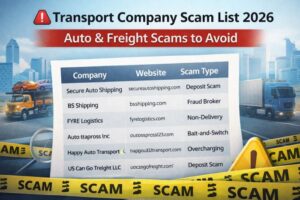






Auto transport scams are becoming increasingly common in the United States. Scammers take advantage of unsuspecting car owners by offering low-cost vehicle shipping services. They often fail to provide the services they promise and may even demand additional payments or not deliver the vehicle at all. It is important to research any auto transport company before entering into an agreement with them. Check customer reviews, ask for references, and make sure the company is registered with the Federal Motor Carrier Safety Administration.
Protect yourself from auto transport scammers :
Start by checking the Better Business Bureau for any complaints about the company. Also,
ask for references from people who have used the company in
the past. Also, make sure that the company you choose is
properly licensed and insured.
Terms and Conditions :
It is also important to make sure you understand the terms and
conditions of the auto transport contract. Make sure that all
of the details, such as pick up and delivery dates and
locations, are clearly stated. Also, be sure to get a written
quote that includes the total cost of the service.
Before signing any contracts, make sure you read the fine
print. Be aware of any additional fees or hidden costs that
may be added to the total cost of the service. Be sure to ask
questions about any hidden fees or charges that you don’t
understand.
Understanding Yelp’s Algorithms :
- Auto transport scams on Yelp typically involve consumers being
duped by a malicious auto transport company. - The company will typically advertise services on Yelp, often at very low prices, that seem too good to be true. When the consumer
contacts the company to arrange their auto transport, the
company will often require a large deposit or full payment
upfront. - After the consumer pays, the company will either not
show up to deliver the vehicle or may deliver a damaged
vehicle that was not disclosed prior to payment. - Another common auto transport scam on Yelp is a bait and
switch. This occurs when a company advertises low prices for
auto transport services on Yelp, but when the consumer
contacts the company, the company will try to upsell them on
more expensive services. - The consumer is offered a discount or bonus if they pay for the more expensive services. The
consumer pays for the more expensive services, but the company
fails to deliver on the promised discount or bonus. - Auto transport scams can be avoided by researching the company
prior to committing to a service. Consumers should read
reviews on Yelp as well as other consumer review sites to get
an idea of the company’s reputation. - It is also important to confirm the company’s insurance information prior to
committing to a service. Finally, it is important to remember
that if a price seems too good to be true, it likely is.
How to identify auto transport scammers :
Auto transport scams are a growing problem in the industry, as
more people look to save money by using a transport service to
move their vehicle from one place to another. The scammer
typically poses as a legitimate auto transporter, making
promises of low prices and quick delivery times. However, they
often fail to deliver on their promises and can leave victims
out of pocket and without a vehicle.
To help you identify auto transport scammers, here are some
key warning signs to look out for:
- Unusually Low Cost: If an auto transport company is
offering an unusually low price, it’s likely too good to be
true. Quality auto transport services come at a price, and
low-cost companies often cut corners to save money. - Requests for a Down Payment: Legitimate companies usually
request full payment upfront, but scammers often request a
down payment. This is a red flag as it allows the scammer to
take your money and disappear without providing a service. - Poor Reviews: Before you sign up with a company, be sure to
check online reviews. If the company has a pattern of negative
reviews, it’s best to avoid them. - Lack of Professionalism: Auto transport scams often lack
professionalism. The scammer may not have a business website
or offer customer support. They may also use a generic email
address, or answer calls in an unprofessional manner. - Poor Communication: Scammers often fail to respond to
emails or phone calls in a timely manner. If you feel like
you’re not being answered, it’s likely that the company is
hiding something. - No Insurance: Transport companies with no insurance are a
red flag. Make sure the company you are considering is insured
and can provide proof. - Unmarked Trucks: Legitimate transport companies usually
have clear, visible branding on their trucks. If the truck
does not have a logo or other identifying marks, it’s a sign
that the company is not legitimate. - Request for Personal Information: Scammers often ask for
personal information like Social Security numbers or bank
account information. Legitimate companies should only ask for
information necessary for the transport.
By following these tips, you can help protect yourself from
auto transport scams. Be sure to do your research and ask
questions before signing up with a company. If something seems
too good to be true, it probably is and it’s best to avoid the
company.