



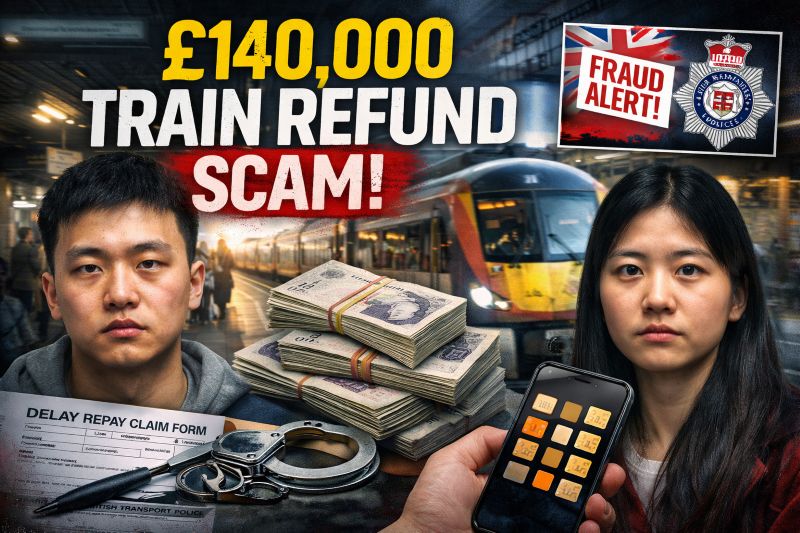
A major UK railway scam has exposed serious flaws in the country’s train compensation system after two university students successfully defrauded rail operators of more than £140,000 by exploiting a loophole in the widely used Delay Repay refund scheme.
The scam was carried out by Li Liu (26) and Wanqing Yu (25), who were living together in a student flat in Leeds, West Yorkshire. According to prosecutors, the pair identified a critical weakness in the rail refund process that allowed them to claim multiple payouts for the same delayed train journeys—without triggering any automated checks.
How the Train Refund Fraud Worked
Court proceedings revealed that the UK’s Delay Repay system did not automatically verify whether a passenger had already received a refund for a specific ticket. The students took advantage of this gap by first requesting refunds for tickets under the claim that they had cancelled their journeys. If the same train later ran late, they would then submit additional Delay Repay compensation claims for the exact same journeys, effectively double-dipping on refunds.
To keep the fraud hidden, Liu and Yu created 16 fake identities, opened numerous bank accounts, and used a 20-SIM card adapter in a single mobile phone. This allowed them to submit claims that appeared to come from different people and locations across the UK, making the scam harder to detect.
This case is part of a wider pattern of railway and transport fraud, similar to incidents highlighted in The Great Train Ticket Scam, where scammers exploit weaknesses in ticketing and refund systems.
£140,000 Rail Fraud Went Undetected for Years
Investigators found that Li Liu fraudulently obtained £141,031, while Wanqing Yu received £15,712 through the scheme. The fraud began as early as 2021 and impacted multiple train operators nationwide. The operation only came to light when CrossCountry Trains noticed suspicious refund activity, prompting a wider investigation by the British Transport Police.
Officers later confirmed that several rail companies had been affected, highlighting how widespread and costly the abuse of the compensation system had become.
Court Verdict and Sentencing
Both students pleaded guilty to conspiracy to defraud and possession of criminal property. During sentencing, Judge Howard Crowson criticised the pair for deliberately exploiting a known weakness in the system, noting the level of planning involved through fake identities, multiple accounts, and concealment tactics.
Li Liu was sentenced to 30 months in prison, while Wanqing Yu received a 17-week sentence, taking into account time already spent in custody.
Why This Railway Scam Matters
This case highlights a growing trend in railway and transport fraud, where criminals exploit digital ticketing systems, automated refunds, and weak verification controls. As train operators increasingly rely on online compensation schemes and customer-friendly refund policies, experts warn that system vulnerabilities can quickly become targets for organised fraud.
The £140,000 train refund scam serves as a stark reminder that even public transport systems are not immune to sophisticated financial abuse—and that stronger safeguards are urgently needed to protect both operators and honest passengers.
The train refund scam was uncovered following a British Transport Police investigation, after operators flagged suspicious claims under the Delay Repay compensation scheme. Authorities say the case highlights growing risks in the UK rail refund system, as digital compensation platforms become targets for fraud.
🚨 Been affected by a train ticket or refund scam?
👉 Report a Scam Here and help protect others.